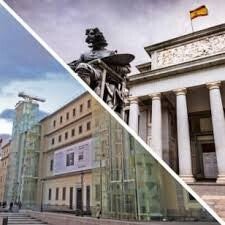
The Museo Nacional Centro de Arte Reina Sofía and Museo Nacional Thyssen-Bornemisza are two essential parts of Madrid’s celebrated Golden Triangle of Art.
Together with the Prado Museum, they allow visitors to explore centuries of European and international art. The Thyssen-Bornemisza provides a broad journey from medieval painting to modern art, while the Reina Sofía concentrates on twentieth-century and contemporary art.
Visiting both museums reveals how Western art developed from Renaissance portraiture and Impressionism to Cubism, Surrealism, abstraction and today’s global contemporary practices.
Understanding Madrid’s Golden Triangle of Art
Madrid’s Golden Triangle consists of:
- Prado Museum
- Thyssen-Bornemisza National Museum
- Reina Sofía National Art Centre Museum
The three museums stand along or near Paseo del Prado, within Madrid’s UNESCO-listed Landscape of Light.
Their collections complement one another:
- The Prado is strongest in European art from the Renaissance to the nineteenth century.
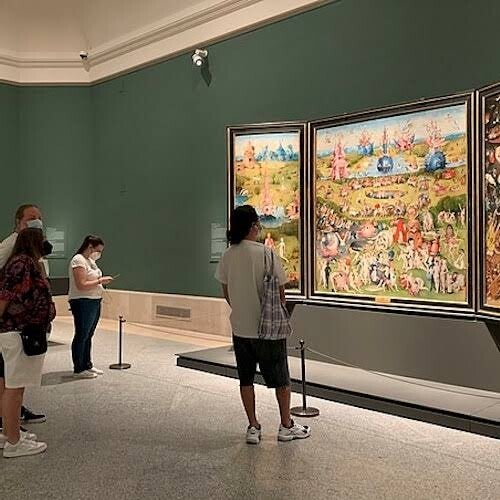
- The Thyssen connects medieval art with Impressionism, Expressionism and early modernism.
- The Reina Sofía concentrates on modern and contemporary art, particularly Spanish art from the twentieth century onwards.
The Thyssen and Reina Sofía are approximately 15–20 minutes apart on foot.
Part One: Reina Sofía Museum
A Brief History of the Reina Sofía
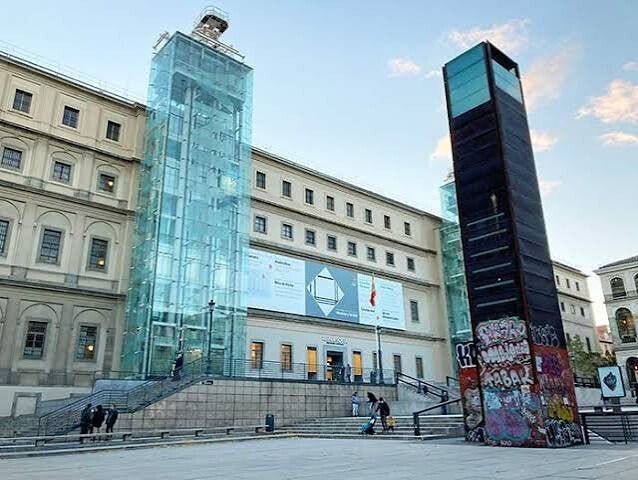
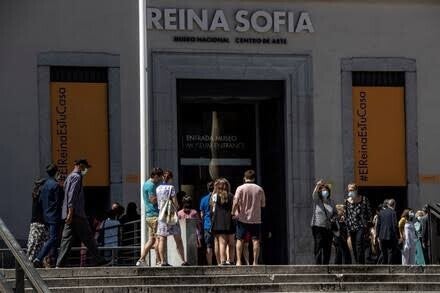
The Reina Sofía’s principal Sabatini Building began as Madrid’s General Hospital.
King Philip II had wanted to centralise the city’s hospitals during the sixteenth century. In the eighteenth century, King Ferdinand VI commissioned a new hospital building. Work continued under King Charles III, with architects José de Hermosilla and Francesco Sabatini playing important roles in its design.
The hospital operated for generations before closing in 1965. The historic building was later threatened with demolition, but it was declared a protected Historic-Artistic Monument in 1977.
Restoration began during the 1980s. The building first opened as an arts centre in 1986 and became the Museo Nacional Centro de Arte Reina Sofía in 1992.
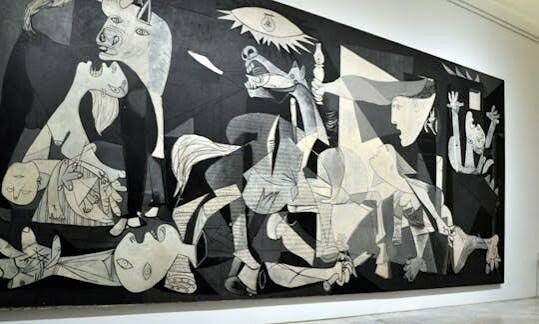
The museum’s most famous work, Pablo Picasso’s Guernica, was transferred from the Prado’s Casón del Buen Retiro to the Reina Sofía in 1992.
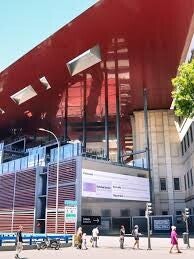
British architect Ian Ritchie designed the distinctive exterior glass lifts attached to the historic building.
As the collection and visitor numbers grew, the museum required additional space. A major extension designed by French architect Jean Nouvel opened in 2005. The Nouvel Building contains exhibition halls, auditoriums, a library, bookshop, restaurant and a large covered courtyard.
What the Reina Sofía Represents
The Reina Sofía is Spain’s national museum of modern and contemporary art.
Its collection examines artistic modernity through:
- Painting
- Sculpture
- Photography
- Film
- Video
- Installation
- Graphic art
- Architecture
- Documents and archives
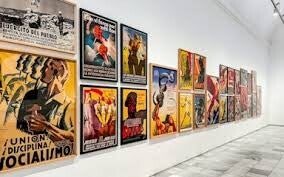
The collection pays particular attention to Spanish history, the Civil War, exile, dictatorship, democracy, feminism, decolonisation and the relationship between artistic experimentation and political change.
Guernica by Pablo Picasso
The museum’s most famous painting is Picasso’s Guernica, completed in 1937.
The Spanish Republican government commissioned Picasso to create a work for the Spanish Pavilion at the Paris International Exposition. He responded to the bombing of the Basque town of Guernica on 26 April 1937 by German and Italian aircraft supporting General Francisco Franco’s Nationalist forces.
Rather than depicting the attack literally, Picasso created an enormous black, white and grey composition filled with fractured bodies, grief, terror and destruction.
Picasso requested that the painting should not return permanently to Spain until democracy had been restored. It arrived in Spain in 1981 and was installed at the Prado’s Casón del Buen Retiro before moving to the Reina Sofía in 1992.
Other Reina Sofía Highlights
Important artists and works include:
- Salvador Dalí’s The Great Masturbator
- Joan Miró’s Snail, Woman, Flower, Star
- Ángeles Santos’s A World
- Maruja Mallo’s The Fair
- Juan Gris
- Julio González
- María Blanchard
- Antoni Tàpies
- Eduardo Chillida
- Jorge Oteiza
- Louise Bourgeois
- Francis Bacon
- Richard Serra
- Lucio Fontana
The collection is periodically reorganised. Check the museum map because galleries and displayed works may change.
Reina Sofía Location
Museo Nacional Centro de Arte Reina Sofía
Calle de Santa Isabel, 52
28012 Madrid
Spain
A second principal entrance is located at:
Nouvel Building
Ronda de Atocha, 2
28012 Madrid
Visitors who have purchased tickets online may find the Nouvel entrance particularly convenient.
Getting to the Reina Sofía Locally
By Metro
The nearest stations are:
Estación del Arte
- Line 1
- Approximately five minutes on foot
Atocha
- Line 1
- Convenient for the station and southern side of the museum
Lavapiés
- Line 3
- Approximately 10–15 minutes on foot
By Cercanías Train
Use Madrid-Atocha, which is within a short walk of the museum.
By Bus
Numerous EMT services stop nearby, including:
- 001
- 6
- 10
- 14
- 19
- 26
- 27
- 32
- 34
- 36
- 37
- 41
- 45
- 59
- 85
- 86
- 102
- C03
- E1
Consult Madrid’s official transport planner for the correct stop and live service information.
By Bicycle
BiciMAD docking stations are available around:
- Ronda de Atocha
- Calle Argumosa
- Cuesta de Moyano
- Calle Santa Isabel
Park bicycles only in authorised areas.
Reina Sofía Opening and Closing Times
The main Sabatini and Nouvel buildings normally operate as follows:
Monday
10:00–21:00
Tuesday
Closed
Wednesday to Saturday
10:00–21:00
Sunday
10:00–14:30
Visitors should remember that some sections may begin closing before the published final time.
Annual Closing Days
The museum normally closes on:
- 1 January
- 6 January
- 1 May
- 15 May
- 9 November
- 24 December
- 25 December
- 31 December
Some local-holiday closures may change according to the official calendar of the Community of Madrid. Verify the schedule before travelling.
Reina Sofía Entry Fees
General Admission
€12
This provides access to the collection and included temporary exhibitions.
Ticket Valid for Two Visits
€18
This allows a visitor to return for a second visit within one year, subject to the museum’s conditions.
General Admission with Audio Guide
€18
Individual Audio Guide
- Standard: €6
- Eligible reduced rate: €5
A combined reduced ticket with an audio guide may be available for €12, subject to eligibility.
Reduced Admission
A 50% reduction may apply to qualifying cultural volunteers, members of large families and other eligible groups. Documentation is required.
Free Admission Categories
Free admission may be available to qualifying visitors, including:
- People under 18
- Visitors over 65
- Eligible students
- People with disabilities
- Unemployed visitors receiving qualifying benefits
- Certain teachers and cultural professionals
Some free or reduced tickets can only be collected from the ticket office with valid identification.
Reina Sofía Free-Entry Periods
Free admission for individual visitors is normally available:
- Monday: 19:00–21:00
- Wednesday to Saturday: 19:00–21:00
- Sunday: 12:30–14:30
A free ticket is still required and can be reserved online.
Free entry is also normally offered on designated dates, including:
- 18 April
- 18 May
- 22 May
- 12 October
- 6 December
Free-entry periods can be very busy. The museum identifies mornings between 10:00 and 12:00 and the beginning of the evening free period as its busiest times. A quieter visit may be possible between 14:00 and 18:00.
Reina Sofía’s Retiro Park Venues
The museum also manages:
- Palacio de Velázquez
- Palacio de Cristal
Both are located in El Retiro Park and normally offer free admission.
Operating hours change by season. The Palacio de Cristal may be closed temporarily for restoration, while the Palacio de Velázquez’s exhibition schedule varies. Check the museum website before making a special journey.
Part Two: Thyssen-Bornemisza National Museum
A Brief History of the Thyssen-Bornemisza Collection
The Thyssen-Bornemisza collection was developed by the Thyssen family, a prominent European industrial family.
Baron Heinrich Thyssen-Bornemisza began assembling an important art collection during the early twentieth century. He acquired European paintings across periods and national schools, creating a collection broader in scope than many traditional aristocratic collections.
His son, Baron Hans Heinrich Thyssen-Bornemisza, significantly expanded the holdings. He collected early European painting, Impressionism, Post-Impressionism, German Expressionism, American art and twentieth-century modernism.
The collection was initially associated with the family’s residence at Villa Favorita in Lugano, Switzerland.
During the late twentieth century, the Spanish government negotiated to bring the collection to Madrid. The works were initially loaned to Spain, and the museum opened in 1992.
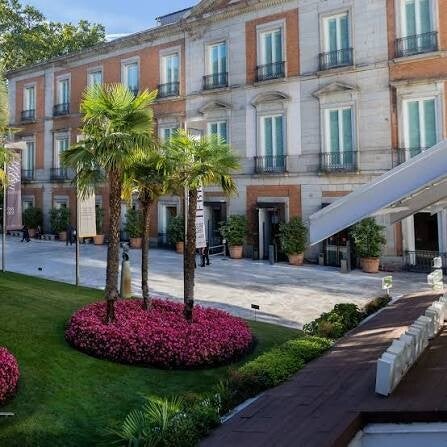
The Spanish state purchased the core collection in 1993. It was installed in the eighteenth-century Villahermosa Palace, which had been redesigned for museum use by architect Rafael Moneo.
The collection of Carmen Thyssen-Bornemisza later added further strength, particularly in nineteenth-century landscapes, Impressionism and related movements.
Why the Thyssen Collection Is Important
The collection fills historical gaps between the holdings of the Prado and Reina Sofía.
Its galleries allow visitors to follow a broad chronological journey through:
- Medieval religious painting
- Renaissance portraiture
- Baroque painting
- Dutch and Flemish art
- Romanticism
- Realism
- Impressionism
- Post-Impressionism
- Expressionism
- Cubism
- Surrealism
- Pop Art
- Twentieth-century abstraction
The museum is particularly valuable for visitors who want a clear overview of European and American art across several centuries.
Artists to Look For at the Thyssen
The collection includes works associated with artists such as:
- Duccio
- Jan van Eyck
- Albrecht Dürer
- Caravaggio
- Rubens
- Rembrandt
- Canaletto
- Goya
- Caspar David Friedrich
- Édouard Manet
- Claude Monet
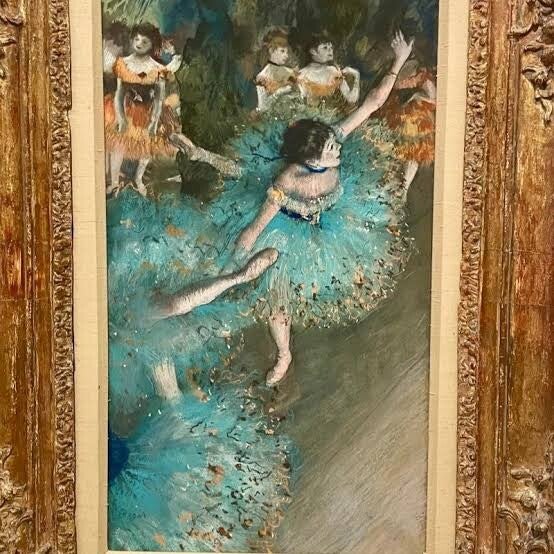
- Edgar Degas
- Pierre-Auguste Renoir
- Vincent van Gogh
- Paul Gauguin
- Paul Cézanne
- Wassily Kandinsky
- Pablo Picasso
- Piet Mondrian
- Salvador Dalí
- Edward Hopper
- Georgia O’Keeffe
- Roy Lichtenstein
Displayed works can change because of loans, conservation and temporary exhibitions.
Thyssen-Bornemisza Museum Location
Museo Nacional Thyssen-Bornemisza
Paseo del Prado, 8
28014 Madrid
Spain
The museum occupies Villahermosa Palace, close to:
- Prado Museum
- Neptune Fountain
- Congress of Deputies
- Cibeles Palace
- Barrio de las Letras
- Royal Botanical Garden
- CaixaForum Madrid
Getting to the Thyssen Locally
By Metro
The nearest stations are:
Banco de España
- Line 2
Sevilla
- Line 2
Estación del Arte
- Line 1
- Slightly farther away but useful when combining the Thyssen with the Prado or Reina Sofía
By Cercanías Train
Useful stations include:
- Madrid-Atocha
- Madrid-Recoletos
- Madrid-Sol
Continue by walking, Metro or bus.
By Bus
Many EMT services operate along Paseo del Prado, Calle de Alcalá and nearby streets. Check the official transport planner for the most suitable route from your accommodation.
On Foot
Approximate walking times are:
- Prado Museum: 5–10 minutes
- Cibeles Palace: 10 minutes
- Puerta del Sol: 10–15 minutes
- Reina Sofía Museum: 15–20 minutes
- El Retiro Park: 10 minutes
- Gran Vía: 15 minutes
Thyssen Opening and Closing Times
Permanent Collection
Monday: 12:00–16:00
Monday access to the permanent collection is normally free under the museum’s sponsored programme.
Tuesday to Sunday: 10:00–19:00
Saturday Evening Programme
Some galleries or temporary exhibitions may remain open on Saturdays until 23:00, with free admission between 21:00 and 23:00 under the Thyssen Nights programme.
The exact areas included depend on the exhibition programme. Check the museum’s schedule for the date of your visit.
Holiday Closures
The museum normally closes on:
- 1 January
- 1 May
- 25 December
Reduced Holiday Hours
On 24 and 31 December, the museum normally opens:
10:00–15:00
Temporary exhibitions may follow different schedules from the permanent collection.
Thyssen-Bornemisza Entry Fees
General Admission
€14
Reduced Admission
€10
This may apply to:
- Visitors over 65
- Pensioners
- Eligible students
Group Admission
For groups of seven or more:
€12 per person
Group booking conditions apply.
Free Admission
Free admission normally applies:
- Monday from 12:00–16:00
- Saturday from 21:00–23:00 for the galleries included in Thyssen Nights
- 18 May, International Museum Day
- 12 October, Spain’s National Day
- Eligible visitors under 18, subject to current conditions
The Monday programme generally applies to the permanent collection. Temporary exhibitions may require a separate ticket unless expressly included.
Connecting with Both Museums Internationally
By Air
International visitors normally arrive at Adolfo Suárez Madrid-Barajas Airport.
The airport is connected to central Madrid by:
- Metro
- Cercanías train from Terminal 4
- Airport Express bus
- EMT public buses
- Official taxis
- Private transfers
- Recognised ride-booking services
For the Reina Sofía, the Airport Express bus or Cercanías connection towards Atocha can be convenient.
For the Thyssen, continue towards Banco de España, Sevilla, Atocha or central Madrid, depending on your chosen transport.
By International and High-Speed Train
Madrid’s principal long-distance stations are:
- Madrid-Puerta de Atocha-Almudena Grandes
- Madrid-Chamartín-Clara Campoamor
Atocha is particularly convenient for the Reina Sofía and is also within walking distance of the Thyssen.
High-speed trains connect Madrid with Barcelona, Valencia, Seville, Málaga, Zaragoza, Alicante, Córdoba, Granada and many other Spanish cities.
International train passengers commonly connect through Barcelona or northern Spain.
By Long-Distance Coach
Major coach stations include:
- Estación Sur de Autobuses
- Avenida de América
- Moncloa
Continue to the museum district by Metro, public bus or taxi.
Can You Visit Both Museums in One Day?
Yes, but a selective approach is essential.
Suggested One-Day Programme
Morning: Thyssen-Bornemisza
10:00–13:00
Follow the collection chronologically or choose selected sections such as Renaissance painting, Impressionism and twentieth-century art.
Lunch
13:00–14:30
Eat near Paseo del Prado, Barrio de las Letras or Atocha.
Afternoon: Reina Sofía
15:00–18:30
Concentrate on:
- Picasso and Guernica
- Dalí
- Miró
- Spanish Civil War art
- Selected post-war and contemporary galleries
This timetable avoids the beginning of the busy Reina Sofía free-admission period.
For a deeper visit, allocate a separate day to each museum.
Paseo del Arte Pass
The Paseo del Arte Pass provides one visit to:
- Prado Museum
- Thyssen-Bornemisza National Museum
- Reina Sofía Museum
The current published price is approximately €32.80. The pass is valid for one year from purchase, subject to its conditions. It offers a discount compared with buying three full-price tickets separately.
Compare the pass with free-entry periods and personal concessions before purchasing.
Dos When Visiting
- Purchase timed tickets in advance.
- Use official museum websites or authorised sellers.
- Bring identification for free or reduced admission.
- Check which entrance is recommended for online-ticket holders.
- Download or collect a museum map.
- Choose priority artworks before arriving.
- Wear comfortable shoes.
- Keep your telephone on silent.
- Use headphones with audio guides.
- Maintain a respectful distance from artworks.
- Follow room-specific photography signs.
- Use the cloakroom or lockers when instructed.
- Take breaks to prevent museum fatigue.
- Check temporary exhibitions before your visit.
- Ask museum staff for accessibility assistance when necessary.
- Reserve a free-entry ticket even when no payment is required.
- Allow at least two or three hours for each museum.
- Check whether galleries are temporarily closed.
- Remember that free periods can attract large queues.
- Visit between 14:00 and 18:00 if you prefer a quieter Reina Sofía experience.
Don’ts When Visiting
- Do not touch paintings, sculptures, frames or display cases.
- Do not use flash, tripods or selfie sticks.
- Do not assume photography is allowed in every gallery.
- Do not photograph Guernica or other protected works when room signs prohibit it.
- Do not carry large luggage into exhibition areas.
- Do not wear a large backpack on your back near artworks.
- Do not bring food or uncovered drinks into the galleries.
- Do not smoke or use electronic cigarettes.
- Do not make loud telephone calls.
- Do not run through the museum.
- Do not block doorways or emergency exits.
- Do not stand directly in front of a popular painting for an excessive time.
- Do not use pens near artworks if sketching; ask whether pencils are permitted.
- Do not bring unauthorised animals.
- Do not assume all temporary exhibitions are included in a free ticket.
- Do not wait until the final hour to begin a first visit.
- Do not attempt to see both complete collections in a single day.
- Do not rely on old opening hours or admission prices.
- Do not purchase tickets from unofficial street sellers.
- Do not speak loudly during group explanations.
Book Your Madrid Holiday with Virtual World Travel Agency
Would you like to experience the Reina Sofía, Thyssen-Bornemisza and Madrid’s other magnificent cultural attractions?
Virtual World Travel Agency can assist you with accommodation, car rentals, museum and event tickets, customised itineraries and unforgettable Madrid holidays.
WhatsApp or Call: +34 664 663 275
Email: info@virtual-world.pl
Holiday Planner Form:
Plan your holiday with us
Self-Booking Platform for Hotels, Car Rentals and Events:
Book hotels, car rentals and events online
Virtual World Travel Agency — helping you travel with confidence, convenience and unforgettable experiences.
Add comment
Comments