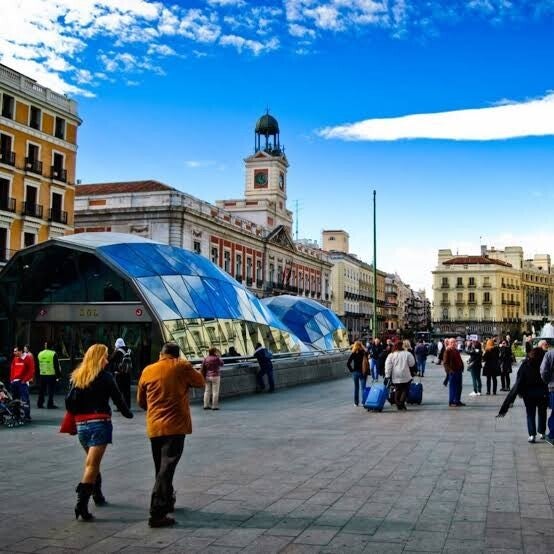
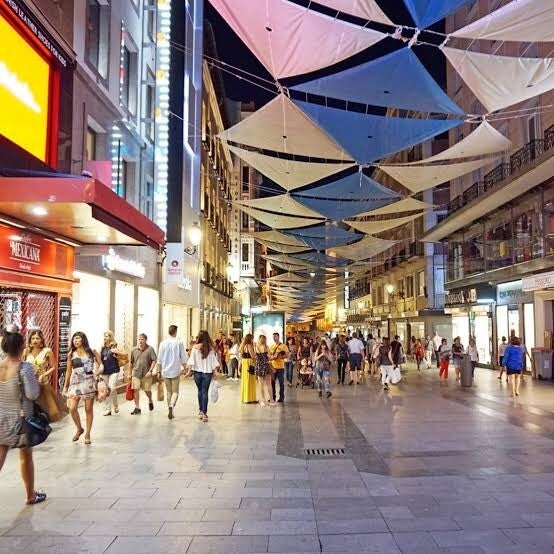
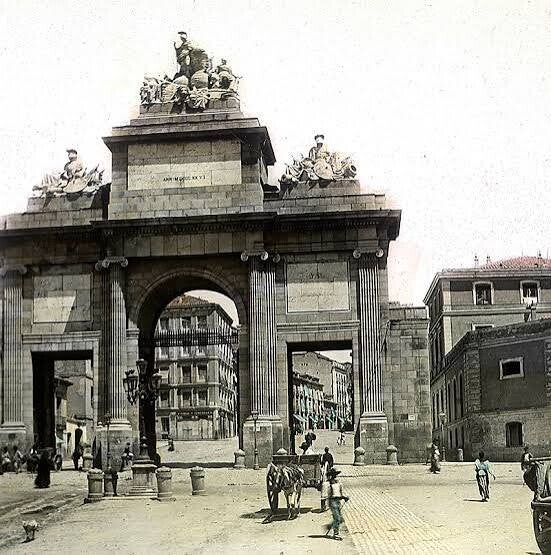
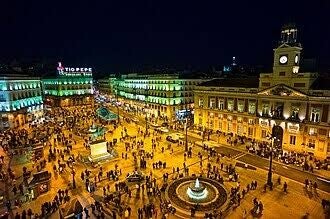
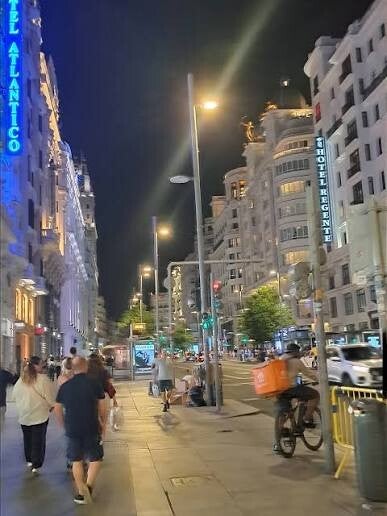
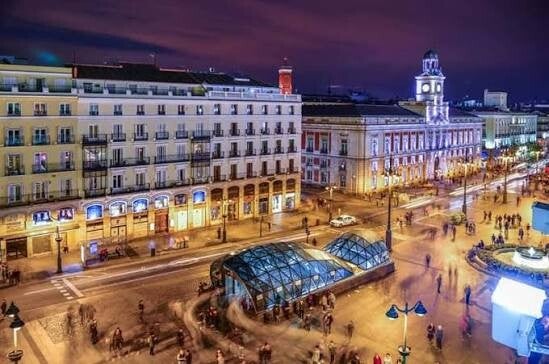
Puerta del Sol and Gran Vía form the energetic heart of Madrid. Together, they offer an exciting combination of history, monumental architecture, shopping, theatres, restaurants, rooftop terraces, entertainment and nightlife.
Puerta del Sol represents Madrid’s historic and geographical centre, while Gran Vía tells the story of the city’s twentieth-century transformation into a modern European capital. Both can be explored comfortably during the same walking tour.
A Brief History of Puerta del Sol
The name Puerta del Sol, meaning “Gate of the Sun,” comes from a gate that once formed part of Madrid’s medieval defensive wall. The gate was reportedly decorated with the image of a sun.
During the medieval period, the gate stood outside the principal urban centre. After the walls were demolished, the surrounding space gradually developed into a busy meeting point where several important roads converged.
Between the seventeenth and nineteenth centuries, Puerta del Sol was a relatively narrow and elongated space formed by the meeting of Calle Mayor, Calle del Arenal, Calle de Alcalá and Carrera de San Jerónimo.
The square acquired its recognisable semicircular form following a major nineteenth-century redevelopment. A competition held in 1857 selected a design by Lucio del Valle, Juan Rivera and José Morer. Their project preserved the alignment of the Real Casa de Correos while creating a coordinated semicircle of buildings on the opposite side.
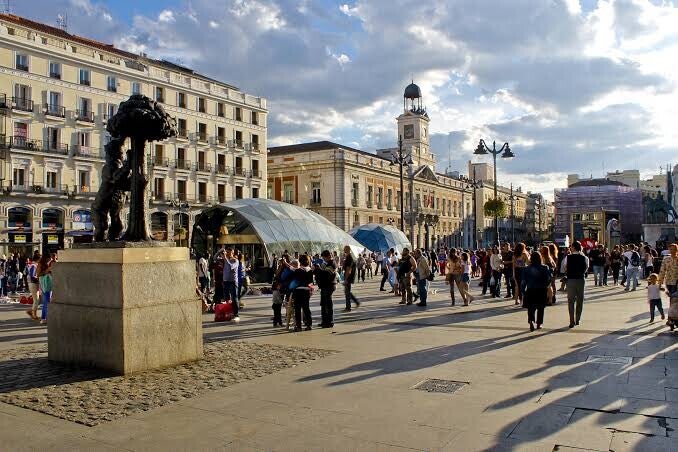
Further renovations took place during the twentieth and twenty-first centuries. Puerta del Sol has now become a largely pedestrianised public space and one of Madrid’s most important meeting points.
The Real Casa de Correos
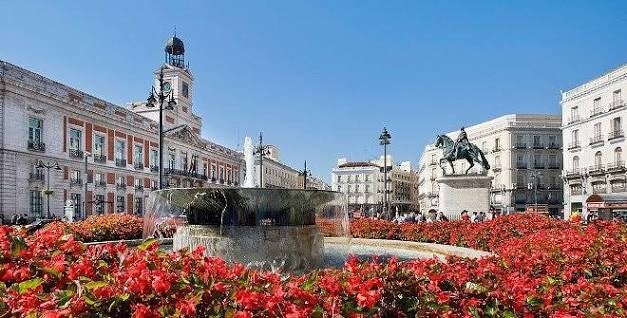
The Real Casa de Correos is the most prominent historic building in Puerta del Sol.
Constructed during the eighteenth century as Madrid’s main post office, it later served several administrative functions. It is now the headquarters of the Presidency of the Community of Madrid.
Its clock is one of the most famous in Spain. Every New Year’s Eve, thousands of people gather in Puerta del Sol to hear its twelve midnight chimes.
A Spanish tradition encourages people to eat one grape with each chime, representing good luck for the twelve months of the coming year. The ceremony is broadcast across Spain and watched by millions of people.
Kilometre Zero
A stone marker in front of the Real Casa de Correos identifies Kilometre Zero.
This symbolic point marks the traditional starting place of Spain’s six principal radial roads. These routes extend from Madrid towards different parts of the country.
Visitors frequently queue to photograph their feet beside the marker. It is one of the smallest but most photographed landmarks in Madrid.
The Bear and the Strawberry Tree
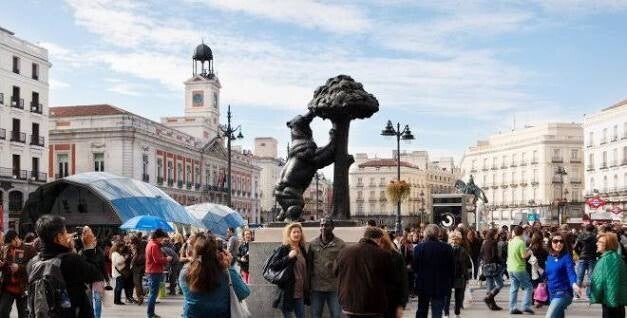
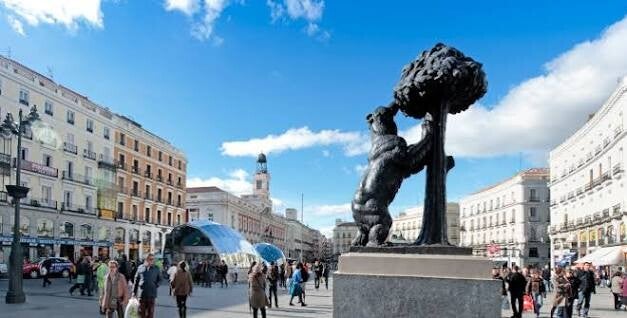
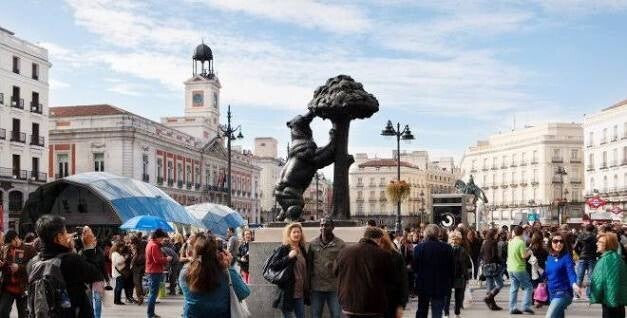
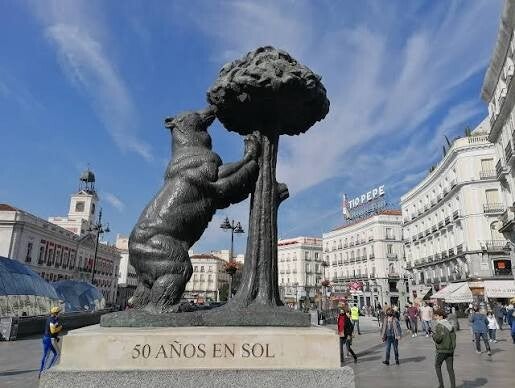
The statue of **El Oso y el Madroño—the Bear and the Strawberry Tree—**represents Madrid’s official heraldic symbol.
The bronze sculpture stands at the eastern side of Puerta del Sol, near Calle de Alcalá. It has become a popular meeting point for residents and visitors.
The bear and tree also appear on Madrid’s coat of arms, although the historical interpretation of the symbol continues to be debated.
The Statue of King Charles III
An equestrian statue of King Charles III occupies a central position in Puerta del Sol.
Charles III reigned during the eighteenth century and introduced extensive urban improvements to Madrid, including roads, fountains, public lighting, sanitation projects and monumental buildings.
His contribution to the capital earned him the popular title of “Madrid’s best mayor.”
La Mariblanca
Near the entrance to Calle del Arenal stands a copy of the seventeenth-century statue known as La Mariblanca.
The original statue once decorated a fountain in Puerta del Sol and is now preserved elsewhere. The current replica recalls the fountains and public monuments that previously occupied the square.
A Brief History of Gran Vía
Gran Vía is Madrid’s most famous modern avenue. Its construction between 1910 and 1931 transformed the centre of the city.
Before Gran Vía was built, the area consisted of a complicated network of narrow streets. City authorities wanted to improve movement between Calle de Alcalá and Plaza de España while creating a grand commercial avenue appropriate for a modern capital.
The project required the demolition or alteration of many buildings and approximately 22 smaller streets. Construction was completed in three principal phases:
- Calle de Alcalá to Red de San Luis
- Red de San Luis to Plaza del Callao
- Plaza del Callao to Plaza de España
Each section reflects the architectural styles popular during the period in which it was completed. Gran Vía therefore resembles an open-air museum of early twentieth-century architecture.
Its new office buildings, department stores, cinemas and entertainment venues represented Madrid’s commercial and cultural modernisation. Some of Spain’s earliest skyscrapers appeared along the avenue, influenced by architectural developments in the United States.
Gran Vía later became famous for its cinemas and theatres. Today, it is sometimes described as Madrid’s Broadway because of its concentration of musicals and stage productions.
Important Buildings on Gran Vía
Metrópolis Building
Located near the junction of Calle de Alcalá and Gran Vía, the Metrópolis Building is one of Madrid’s most photographed landmarks.
Constructed between 1907 and 1910, it is recognised by its elaborate façade, rounded tower and dark dome crowned by a winged Victory figure.
Grassy Building
The Grassy Building stands close to the Metrópolis Building. It is known for its distinctive corner tower, clock and historic association with jewellery and watchmaking.
Telefónica Building
Completed in the late 1920s, the Telefónica Building was among Europe’s early skyscrapers. Its height and American-inspired design symbolised Madrid’s modernisation.
The building played an important communications role during the Spanish Civil War because of its height and telephone facilities.
Capitol Building
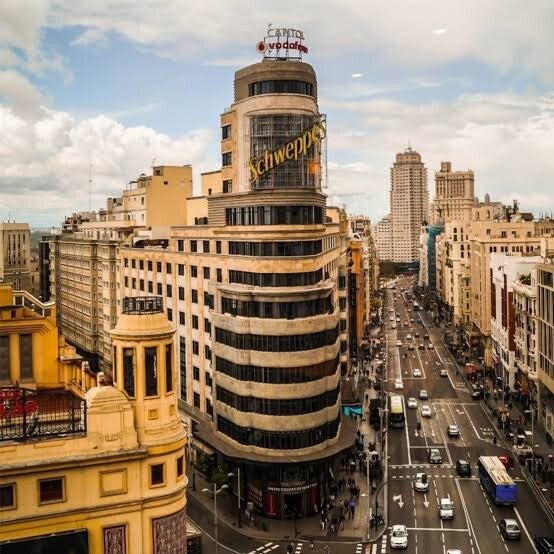
The Capitol Building, also called the Carrión Building, stands close to Plaza del Callao. Its curved façade and illuminated advertising sign make it one of the best-known examples of Madrid’s Art Deco and Streamline Moderne architecture.
Plaza del Callao
Callao is one of Madrid’s busiest public spaces. Surrounded by cinemas, shops, hotels and entertainment venues, it offers a classic view down Gran Vía towards the Capitol Building.
Edificio España
Standing in Plaza de España, this monumental building was completed in 1953. It was once among the tallest buildings in Spain and remains an important feature of Madrid’s skyline.
Torre de Madrid
Also located at Plaza de España, Torre de Madrid was one of Europe’s tallest concrete buildings when completed in the 1950s.
Where Are Puerta del Sol and Gran Vía Located?
Puerta del Sol is situated in Madrid’s Centro district:
Puerta del Sol
28013 Madrid
Spain
Gran Vía extends for approximately 1.3 kilometres between Calle de Alcalá and Plaza de España.
Puerta del Sol lies a short distance south of Gran Vía. The two are connected by several streets, including:
- Calle de la Montera
- Calle de Preciados
- Calle del Carmen
- Calle de Alcalá
A walk from Puerta del Sol to the Gran Vía–Montera junction normally takes approximately five to ten minutes.
How to Get There Locally
Metro Stations for Puerta del Sol
Sol
- Line 1
- Line 2
- Line 3
Other nearby stations include:
- Sevilla: Line 2
- Gran Vía: Lines 1 and 5
- Callao: Lines 3 and 5
- Ópera: Lines 2, 5 and R
Metro Stations for Gran Vía
Different sections of Gran Vía can be reached through:
- Banco de España: Line 2
- Gran Vía: Lines 1 and 5
- Callao: Lines 3 and 5
- Santo Domingo: Line 2
- Plaza de España: Lines 2, 3 and 10
These stations make it easy to walk along only part of the avenue if time or mobility is limited.
By Cercanías Train
Madrid-Sol station is located beneath Puerta del Sol and connects the area with important suburban and mainline transport hubs.
By Bus
Numerous EMT bus routes serve the wider Sol and Gran Vía district. Routes include daytime, express and night services.
Because routes can be diverted during demonstrations, festivals, construction work and major events, check Madrid’s official transport application on the day of travel.
By Bicycle
BiciMAD docking stations are available near:
- Calle Carretas
- Calle Mayor
- Calle Abada
- Plaza de España
- Santo Domingo
- Miguel Moya
- Jacometrezo
- Tres Cruces
- Banco de España
Gran Vía has cycling infrastructure between Callao and Plaza de España, but traffic can be busy. Less experienced cyclists may prefer to park their bicycles and continue on foot.
On Foot
Puerta del Sol is within walking distance of many attractions:
- Gran Vía: 5–10 minutes
- Plaza Mayor: 5–10 minutes
- Royal Palace: 15 minutes
- Almudena Cathedral: 15–20 minutes
- Plaza de España: 20 minutes
- Cibeles Palace: 15 minutes
- Prado Museum: 20–25 minutes
Walking is the best way to enjoy the architecture, shops and atmosphere.
Connecting with Madrid Internationally
By Air
International visitors normally arrive at Adolfo Suárez Madrid-Barajas Airport.
The airport is connected to central Madrid by:
- Metro
- Cercanías commuter train from Terminal 4
- Airport Express bus
- EMT public buses
- Official taxis
- Private transfers
- Recognised ride-booking platforms
Visitors using the Metro will normally make one or more changes to reach Sol or Gran Vía.
Cercanías passengers arriving from Terminal 4 can travel to central stations and connect to Madrid-Sol.
By International and High-Speed Train
Madrid’s principal long-distance stations are:
- Madrid-Puerta de Atocha-Almudena Grandes
- Madrid-Chamartín-Clara Campoamor
High-speed trains connect Madrid with Barcelona, Valencia, Seville, Málaga, Zaragoza, Alicante and many other Spanish cities.
International rail passengers commonly travel through Barcelona, Figueres or other cross-border connections.
From Atocha, Metro Line 1 provides a direct connection towards Sol and Gran Vía. From Chamartín, use Metro or Cercanías services.
By Long-Distance Coach
International and domestic coaches arrive at stations including:
- Estación Sur de Autobuses
- Avenida de América
- Moncloa
Continue by Metro, public bus or taxi.
Opening and Closing Times
Puerta del Sol
Puerta del Sol is a public square and has:
- No formal opening time
- No standard closing time
- Free public access throughout the day and night
Temporary restrictions may apply during:
- New Year’s Eve
- Demonstrations
- Official ceremonies
- Construction work
- Major public celebrations
- Security operations
The buildings around Puerta del Sol contain shops, restaurants, offices and government facilities with separate operating hours. Most historic façades can be viewed only from outside.
Gran Vía
Gran Vía is a public avenue and remains accessible at all times.
There is:
- No formal opening time
- No general closing time
- No admission checkpoint
Individual shops, theatres, cinemas, restaurants, museums, rooftop terraces and entertainment venues determine their own opening hours.
Many restaurants and entertainment venues remain open late, while shops generally operate from morning until evening. Sunday and holiday schedules vary.
Entry Fees
Puerta del Sol
General access: Free
There is no charge to:
- Enter the square
- See Kilometre Zero
- Photograph the Real Casa de Correos
- View the clock
- See the Bear and Strawberry Tree
- See the statues of Charles III and La Mariblanca
Gran Vía
General access: Free
There is no charge to walk along Gran Vía or admire its architecture. Madrid’s official tourism service confirms that admission to the avenue itself is free.
Additional charges apply for:
- Theatre performances
- Musicals
- Cinemas
- Museums and exhibitions
- Rooftop viewpoints
- Guided architectural tours
- Restaurants and cafés
- Nightclubs
- Special experiences
Always verify prices through the attraction’s official website before booking.
What to See and Do at Puerta del Sol
Find Kilometre Zero
Look for the pavement marker outside the Real Casa de Correos.
See the Clock
Observe the clock associated with Spain’s famous New Year’s Eve grape tradition.
Photograph the Bear and Strawberry Tree
This is one of Madrid’s most recognisable symbols and a popular meeting place.
Admire the Real Casa de Correos
Examine the architecture of the eighteenth-century building and its clock tower.
See the Statues
Find the equestrian statue of Charles III and the replica of La Mariblanca.
Walk the Historic Streets
Puerta del Sol connects with several important streets:
- Calle Mayor leads towards Plaza Mayor and the Royal Palace.
- Calle del Arenal leads towards Teatro Real.
- Calle de Alcalá leads towards Cibeles and Puerta de Alcalá.
- Calle Preciados and Calle del Carmen form a major shopping area.
- Carrera de San Jerónimo leads towards Parliament and the museum district.
What to See and Do on Gran Vía
Take an Architectural Walk
Begin at the Metrópolis Building and continue towards Plaza de España. Notice how the architectural styles change along the three historical sections.
Visit Plaza del Callao
Pause for the famous view of the Capitol Building and surrounding cinema architecture.
Attend a Musical or Theatre Production
Gran Vía is Madrid’s principal musical-theatre district. Advance booking is strongly recommended for popular productions.
Enjoy a Rooftop View
Several hotels and commercial buildings offer rooftop terraces overlooking Gran Vía. Some require admission, a reservation or a minimum food-and-drink purchase.
Go Shopping
Gran Vía and its surrounding streets contain:
- International fashion stores
- Spanish brands
- Department stores
- Specialist shops
- Souvenir stores
- Beauty and technology retailers
Explore Nearby Neighbourhoods
Gran Vía provides easy access to:
- Chueca
- Malasaña
- Salesas
- Plaza de España
- Puerta del Sol
- Calle de Alcalá
Suggested Walking Route
Allow approximately three to five hours for a relaxed visit.
- Begin at Puerta del Sol.
- Find Kilometre Zero.
- See the Real Casa de Correos and its clock.
- Photograph the Charles III statue.
- Visit the Bear and Strawberry Tree.
- Walk along Calle de Alcalá.
- Admire the Metrópolis and Grassy buildings.
- Turn into Gran Vía.
- See the Telefónica Building.
- Stop at Plaza del Callao.
- Photograph the Capitol Building.
- Continue towards Plaza de España.
- Finish with a rooftop drink, dinner or theatre performance.
For a shorter route, walk from Puerta del Sol through Calle de la Montera to Gran Vía, continue to Callao and return through Calle Preciados.
Best Time to Visit
Early Morning
This is the best time for quieter streets and unobstructed photographs.
Late Afternoon
Shops, cafés and public spaces become lively, while the changing light highlights the façades.
Evening
Gran Vía is especially attractive when its theatres, cinemas, shops and advertising signs are illuminated.
New Year’s Eve
Puerta del Sol becomes the focus of Spain’s national celebrations. Access is strictly controlled, crowds are extremely dense and security restrictions apply.
Christmas
The district is beautifully illuminated but exceptionally busy. Allow extra time for walking and public transport.
Dos When Visiting
- Wear comfortable walking shoes.
- Begin early if you want less crowded photographs.
- Look upwards to appreciate Gran Vía’s towers, domes and sculptures.
- Keep valuables in a zipped bag worn in front of you.
- Book theatre performances and musicals in advance.
- Check rooftop access conditions before joining a queue.
- Use official ticket platforms.
- Keep receipts for purchases.
- Compare restaurant menus and prices.
- Use pedestrian crossings and obey traffic signals.
- Check the final Metro or Cercanías departure time.
- Carry water and sun protection during summer.
- Allow time to explore nearby streets and neighbourhoods.
- Ask permission before photographing street performers closely.
- Check accessibility arrangements directly with theatres and rooftop venues.
- Confirm public-transport diversions during major events.
Don’ts When Visiting
- Do not leave your telephone or wallet exposed on a café table.
- Do not carry an open backpack in crowded areas.
- Do not accept unsolicited help at cash machines or ticket machines.
- Do not buy theatre tickets from unofficial street sellers.
- Do not stand in cycle lanes while taking photographs.
- Do not cross Gran Vía outside designated crossings.
- Do not block Metro entrances or busy pavements.
- Do not assume every rooftop terrace is free.
- Do not enter private buildings simply to photograph their interiors.
- Do not photograph police operations or security controls closely.
- Do not make excessive noise in nearby residential streets.
- Do not depend on outdated shop, theatre or restaurant hours.
- Do not expect Puerta del Sol to be quiet during evenings, weekends or holidays.
- Do not visit only at street level—Gran Vía’s architectural details are above you.
- Do not rush the experience; allow time for both daytime architecture and evening illumination.
Book Your Madrid Holiday with Virtual World Travel Agency
Would you like to experience Puerta del Sol, Gran Vía and Madrid’s other unforgettable attractions?
Virtual World Travel Agency can assist you with accommodation, car rentals, event tickets, customised itineraries and memorable Madrid holidays.
WhatsApp or Call: +34 664 663 275
Email: info@virtual-world.pl
Holiday Planner Form:
Plan your holiday with us
Self-Booking Platform for Hotels, Car Rentals and Events:
Book your travel services online
Virtual World Travel Agency — helping you travel with confidence, convenience and unforgettable experiences.
Add comment
Comments